How to See Who Someone Recently Followed on Twitter (2026)
See who someone recently followed on Twitter: whether X lists follows newest first, our test on @Google and @Microsoft, and a snapshot for new follows.
Weir Team
Published · Updated · 7 min read
To see who someone recently followed on Twitter, open their Following list: X (Twitter) lists follows mostly newest first, but with no dates.
So the top rows are only a hint about what a competitor or partner brand is watching now. We tested the order on @Google and @Microsoft on 17 November 2026. The accounts that joined X most recently sat around row 20, not at the top.
With Weir connected to Claude or ChatGPT, paste this and swap in the brand you watch:
Use Weir to get the first page of accounts @Google follows with get_x_user_following (one call, no cursor). Tell me how many there are, then list the ones that joined X in the last two years, with their row numbers and join dates.- Open their Following listOn x.com or in the app.
- Check join datesA new account near the top is a proven recent follow.
- Save a dated copyPage 1, about 70 accounts, as a CSV.
- Compare next weekNew names are new follows.
Is the Twitter following list in chronological order?
Mostly, but not cleanly. X's Help Center says nothing about the order, as of 17 November 2026. Its Following FAQs only tell you to tap Following "to see who you've followed."
X's older API docs said results came "with the most recent following first." They added that this order was "subject to unannounced change and eventual consistency issues." X's current API reference states no order at all.
Weir returns X's own order. Our docs call it "mostly most recent first, though X can place some accounts out of that order."
Vendor guides disagree with each other. Circleboom's says the order "is not newest-first." Here's who says what:
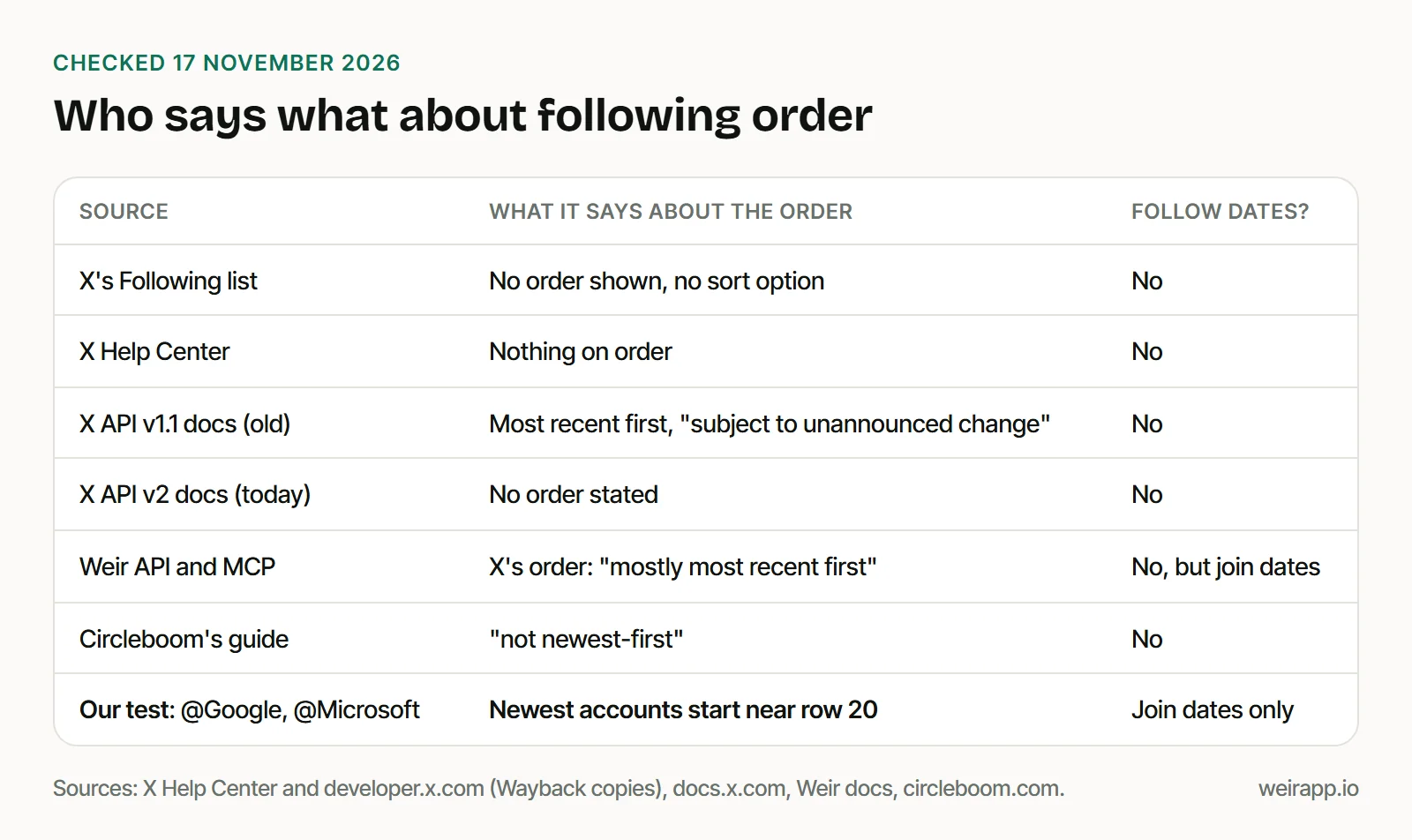
What we found on @Google's and @Microsoft's lists
We read page 1 of both lists through Weir on 17 November 2026, between 16:33 and 16:39 UTC, and checked when each account joined X.
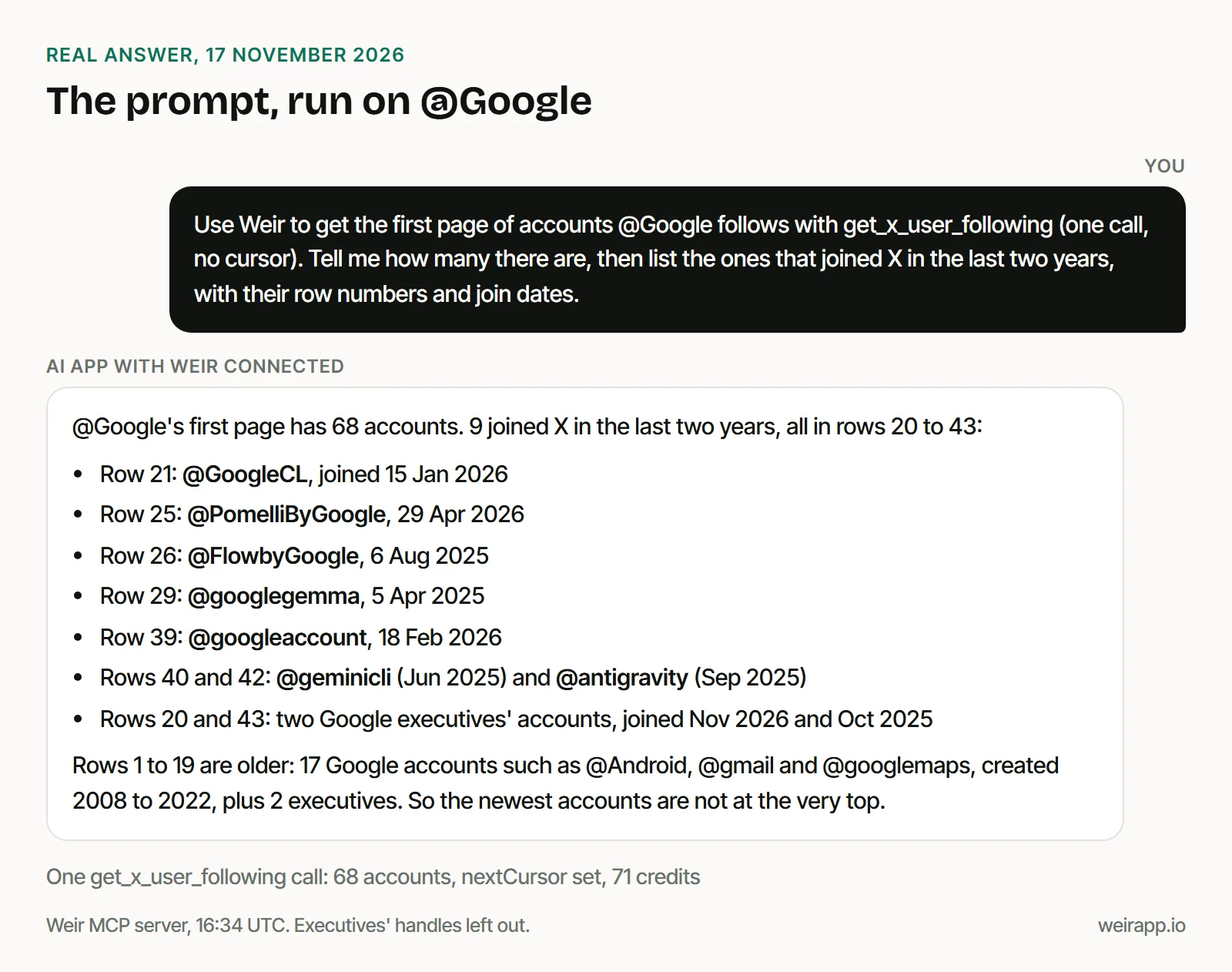
Each list told the same story:
- @Google. The newest account on page 1 joined X on 5 November 2026 and sat at row 20. Above it were 17 Google accounts, such as @Android and @gmail, and 2 executives.
- @Microsoft. Its only accounts created since 2020 sat at rows 24 and 25. Rows 1 to 23 held older accounts, 12 of them Microsoft's own, like @Windows and @MicrosoftTeams.
- @NASA. Our following-list export found the same shape: every account created since 2020 sat in rows 21 to 48.
- Stable. Two reads of @Google's page 1, 3 minutes apart, came back in the same order.
Below the top block, the order looks newest first. All 13 new accounts were on page 1, and page 2 held nothing newer than 2020.
The top block is the puzzle. If X sorted it strictly by follow time, @Google followed 19 long-standing accounts in the 12 days after 5 November 2026. X publishes no follow dates, so we can't tell whether that happened or X placed them there.
How to see who someone recently followed, with proof
Use join dates. Nobody can follow an account before it exists. So if an account on their list joined X last month, they followed it within the last month.
That proves three 2026 follows on @Google's list: @GoogleCL, @googleaccount and @PomelliByGoogle, which joined X in January, February and April 2026.
On x.com, tap the accounts near the top of their Following list. Each profile shows a "joined" date, which X's Help Center also mentions. By API, this script prints the page 1 accounts that joined X in the last two years:
import csv, datetime, glob, json, os, sys, urllib.request

user, today = sys.argv[1], datetime.date.today()
req = urllib.request.Request(f"https://api.weirapp.io/v1/x/users/{user}/following",
                             headers={"Authorization": "Bearer " + os.environ["WEIR_API_KEY"]})
with urllib.request.urlopen(req, timeout=60) as r:  # page 1 only: up to about 70 accounts
    page, credits = json.load(r)["data"], r.headers["x-credits-charged"]
print(f"page 1: {len(page)} accounts, {credits} credits")
for row, a in enumerate(page, 1):  # nobody follows an account before it exists
    if a["createdAt"] >= str(today - datetime.timedelta(days=730)):
        print(f"row {row}: @{a['username']} joined X {a['createdAt'][:10]}")
We ran it on @Google at 16:37 UTC. This is its output, minus rows 20 and 43, two executives' own accounts:
page 1: 68 accounts, 71 credits
row 21: @GoogleCL joined X 2026-01-15
row 25: @PomelliByGoogle joined X 2026-04-29
row 26: @FlowbyGoogle joined X 2025-08-06
row 29: @googlegemma joined X 2025-04-05
row 39: @googleaccount joined X 2026-02-18
row 40: @geminicli joined X 2025-06-23
row 42: @antigravity joined X 2025-09-10
Spot new follows with a dated snapshot
Join dates only catch new accounts. To catch every new follow, save the list and compare it next week. Our free recent follows tool does both in your browser, or add these lines to the script above:
old = sorted(glob.glob(f"{user}-following-*.csv"))  # earlier snapshots, oldest first
path = f"{user}-following-{today}.csv"
with open(path, "w", newline="", encoding="utf-8-sig") as f:
    w = csv.DictWriter(f, ["id", "username", "name", "createdAt"], extrasaction="ignore")
    w.writeheader(); w.writerows(page)
if old and old[-1] != path:  # compare with the last snapshot
    seen = {a["id"] for a in csv.DictReader(open(old[-1], encoding="utf-8-sig"))}
    print("new since", old[-1], [a["username"] for a in page if a["id"] not in seen])
Save it as recent_follows.py and run python recent_follows.py Google once a week. The first run saves a file. Each later run prints the accounts that weren't in the last one.
Want to know which of their follows follow them back? Our free not-following-back checker shows that for any public account.
What does it cost to track someone's follows?
Page 1 costs 1 credit per account, plus 1 for the call and 2 to look up the account. Our @Google read cost 71 credits.
- A weekly snapshot: about 300 credits a month for one account, or $0.06 at the $5 pack's rate.
- Free credits: 5,000 a month cover about 16 accounts checked weekly, and $5 buys 25,000.
If the script doesn't work
- A
404: the account is protected or gone. It costs nothing. - A
429: the free pool is busy. Wait theRetry-Afterseconds, then run it again. - A
402: you're out of credits until the 1st of the month (UTC). - No "new since" line: it's your first snapshot, or a second run on the same day.
When not to use Weir
- You check one account once. Scroll their Following list on X. It's free.
- You need exact follow dates. Neither X nor Weir has them.
- The account is protected. Weir can't read it and answers
404, at no charge. - It's a private person. Use this on brands and organisations, never to watch someone.
Weir isn't licensed by X, so access can change. X's Terms of Service say you "cannot scrape the Services without X's express written permission." This isn't legal advice.
FAQ
Is the Twitter following list in order?
Mostly newest first. X's older API docs said so, and Weir's docs agree. X itself says nothing. In our test on @Google and @Microsoft, about 20 older accounts sat above the newest ones, so don't read row 1 as the latest follow.
How do I see someone's full following list on X?
Open their profile, tap Following and scroll. X has no export button. Weir's API reads a public account's whole list, about 70 accounts per call.
Why is the Twitter following list not in chronological order?
X doesn't explain it. Its older docs warned the order was "subject to unannounced change." In our test, the top rows held mostly each brand's own long-standing accounts, above the newer follows.
Can you see when someone followed an account?
No. X shows no follow dates, and an X archive lists ids and links only. A join date gives the earliest a follow could have happened, and a dated snapshot narrows it to a week.
How do I track who an account follows?
Save its list every week and compare, as in the snapshot script above. The same works for followers: see how to export Twitter followers to CSV, and for people who left, who unfollowed me on Twitter.
Sources
Checked 17 November 2026. X's help pages are Wayback copies, dated in brackets:
- X Help Center, Following FAQs (17 October 2026): https://help.x.com/en/using-x/following-faqs
- X Help Center, About this account and the joined date (8 May 2026): https://help.x.com/en/managing-your-account/how-to-change-country-settings
- X developer docs, GET friends/ids, v1.1 (16 January 2026): https://developer.x.com/en/docs/x-api/v1/accounts-and-users/follow-search-get-users/api-reference/get-friends-ids
- X API v2 reference, Get Following: https://docs.x.com/x-api/users/get-following
- Circleboom, recent following activity (updated 21 October 2026): https://circleboom.com/blog/how-to-see-someones-twitter-recent-following-activity/
- An X archive README, 25 December 2022, published by BitFolk: https://bitfolk.com/twitter-archive/data/README.txt
- X Terms of Service, effective 9 October 2026 (14 November 2026): https://x.com/en/tos
- Weir docs: https://docs.weirapp.io/reference/x/getXUserFollowing and https://docs.weirapp.io/billing
- Our runs through Weir, 17 November 2026, 16:33 to 16:39 UTC: @Google page 1 twice (MCP and REST), @Google page 2 and @Microsoft page 1 (MCP), 260 credits